What Are The Human Design Variables?
What I love about Human Design is its practicality. It’s encouraging to learn something and have the confidence to begin applying it in your life straight away. Following your Strategy and honoring your Authority alone can have a profound impact on how you move through life, and both of these aspects are at the core of Human Design…but understanding your variables is like being handed the blueprint for your personal evolution.
Variables Basics
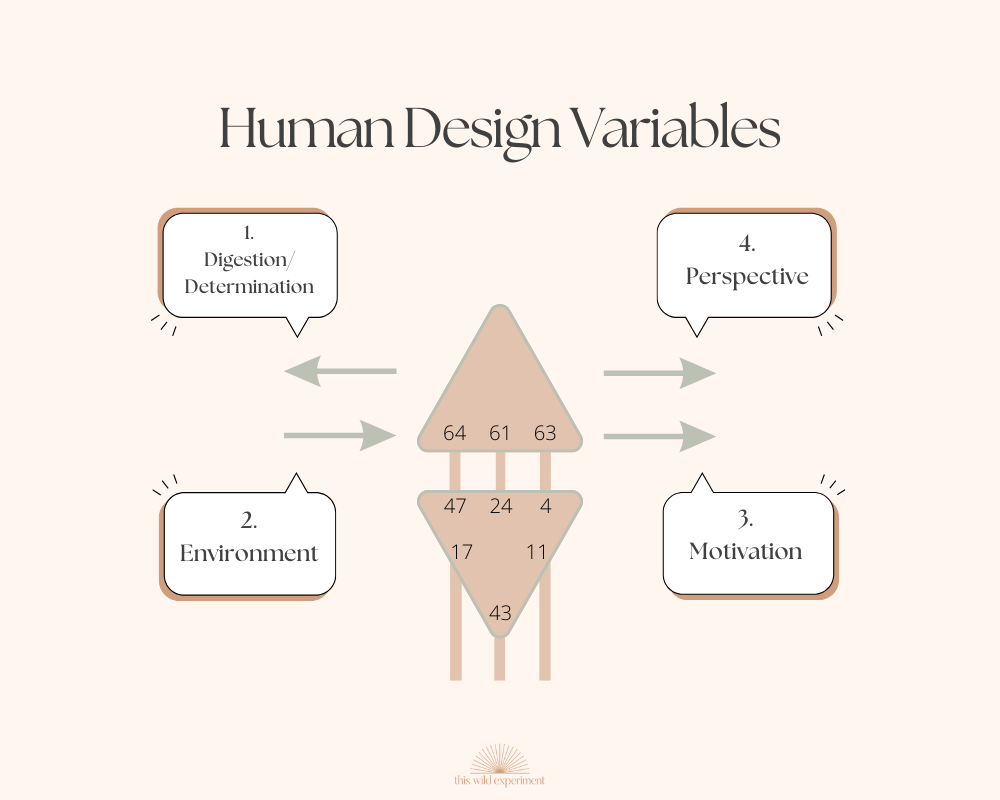
There are 4 arrows you’ll see around the head of your chart – those arrows, and their components, make up your Human Design variables. While your arrow ‘configuration’ as a whole provides so much insight (this layer goes deep), each arrow works in steps – not necessarily something we need to work towards and check off in order, but more of an aspect of ourselves that unfolds naturally if the previous step is aligned. So –
- Step One – Digestion (also referred to as Determination): This is all about how you consume food, information, energy – just because you’re consuming something doesn’t mean it’s nourishing for you, or in the correct way. There is a unique way in which digestion best supports your system.
- Step Two – Environment: Your Environment sets your storyline, and it’s the life you’re here to live. Place is everything here. Your physical environment can either drain or delight you. It can either guide you towards feeling confident in your place in the world around you, or it can keep you stuck in old patterns.
- Step Three – Motivation: This is the step that will take you from reacting to living in flow. It’s understanding what innately drives you to think the way you do.
- Step Four – Perspective: This is the key to understanding the lens through which you experience reality. Awareness emerges when there is true (not forced) alignment with all 4 variables.
In short, it all begins with being intentional about how we nourish our bodies. When the inner self feels nourished, we begin to look for ways to expand on and find support in our physical environment. In feeling supported in both our bodies and spaces, we begin to understand what drives us as individuals to think the way we do. All of which creates a stronger alignment with our perspective and, ultimately, awareness around how we interact with ourselves and others. This is not about changing your mindset or wrestling with willpower, but understanding how you’re designed to function with ease.
Personally, I have a deep interest in the Environment variable, which I will explore further on this blog. While I understand that Human Design teaches all of the variables (and their layers) as interconnected pieces, I’m of the opinion that sometimes…making tangible updates to the space around us is far less complicated than focusing on the inner work…and sometimes that’s exactly what we need. There. I’ve said it. So when it comes to determining your Human Design variables, all you need to do is run your chart and check your type next to Digestion, Environment, Motivation, and Perspective.
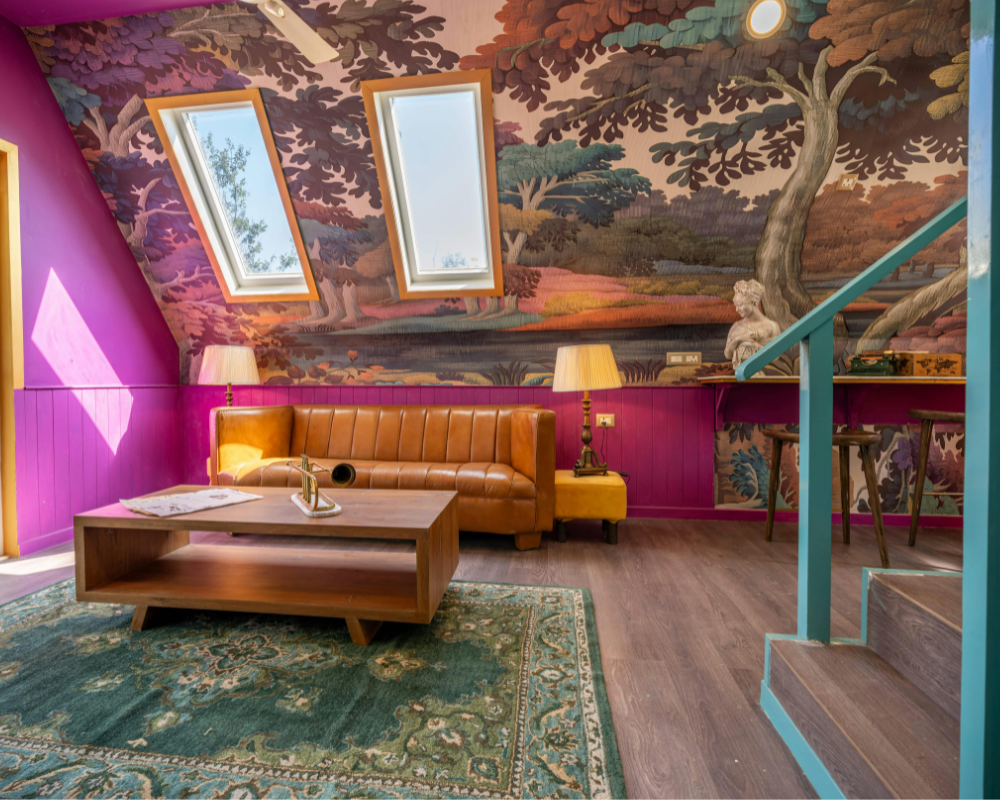
The Role Your Human Design Variables Play In Your Home
There is so much (very useful) information out there on how to arrange your furniture and curate your space, but a deeper understanding of your Environment variable can help decipher why some ‘perfect on paper‘ design ideas feel off. Some people are designed for busy, interactive spaces, while others prefer retreating to a cozy nook. Some feel inspired by spaces where they can be creative, and others find clarity when they can see their surroundings without distraction.
Just imagine – someone who is designed for a quiet, focused, and enclosed environment, spending most of their time in an open-concept area with large windows, bold colors, and constant noise and interaction. While that open-concept room can look stunning and be arranged with design principles in mind, that person will never feel fully aligned in that environment. Their nervous system will never truly feel at ease. Now picture the opposite: someone who’s designed for bright, bold, and interactive spaces, living in a minimalist, neutral-colored space. Again, a beautiful concept, but not inspiring for that individual’s design.
It’s just a matter of their environment not matching their design.
Practical Applications
Keeping with our practical, experimental approach, over the next few posts, I’ll be diving into each Environment type and how you can apply those principles to your home, your routine, and the space around you. Instead of seeing something on Pinterest and recreating it, let’s hone in on what kind of space best supports you, how much visual stimulation you’re built for, and how you naturally focus, relax, and find inspiration.
If you’re interested in diving deeper using journal prompts for your Human Design type before exploring your Environment variable, check out this post: Journal Prompts for each Human Design Type.